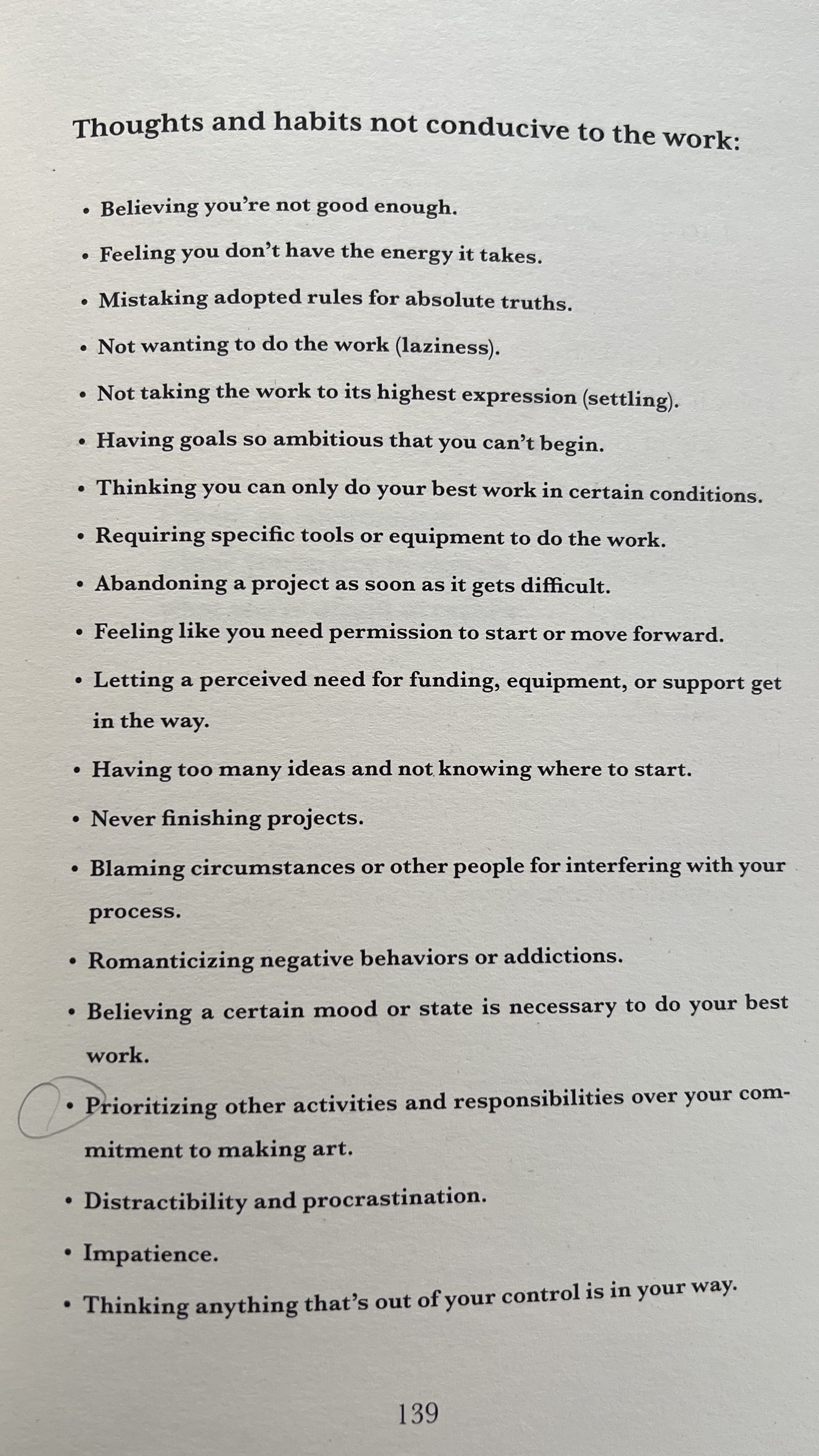
No one’s roasted me as bad as page 139 in The Creative Act. Someone call Comedy Central, an innocent woman has been roasted.
Bullied by a long-bearded producer. I believe nobody had made such a list of human shortcomings since Moses. Whoever hasn’t done ANY of these, be the first to cast a stone.
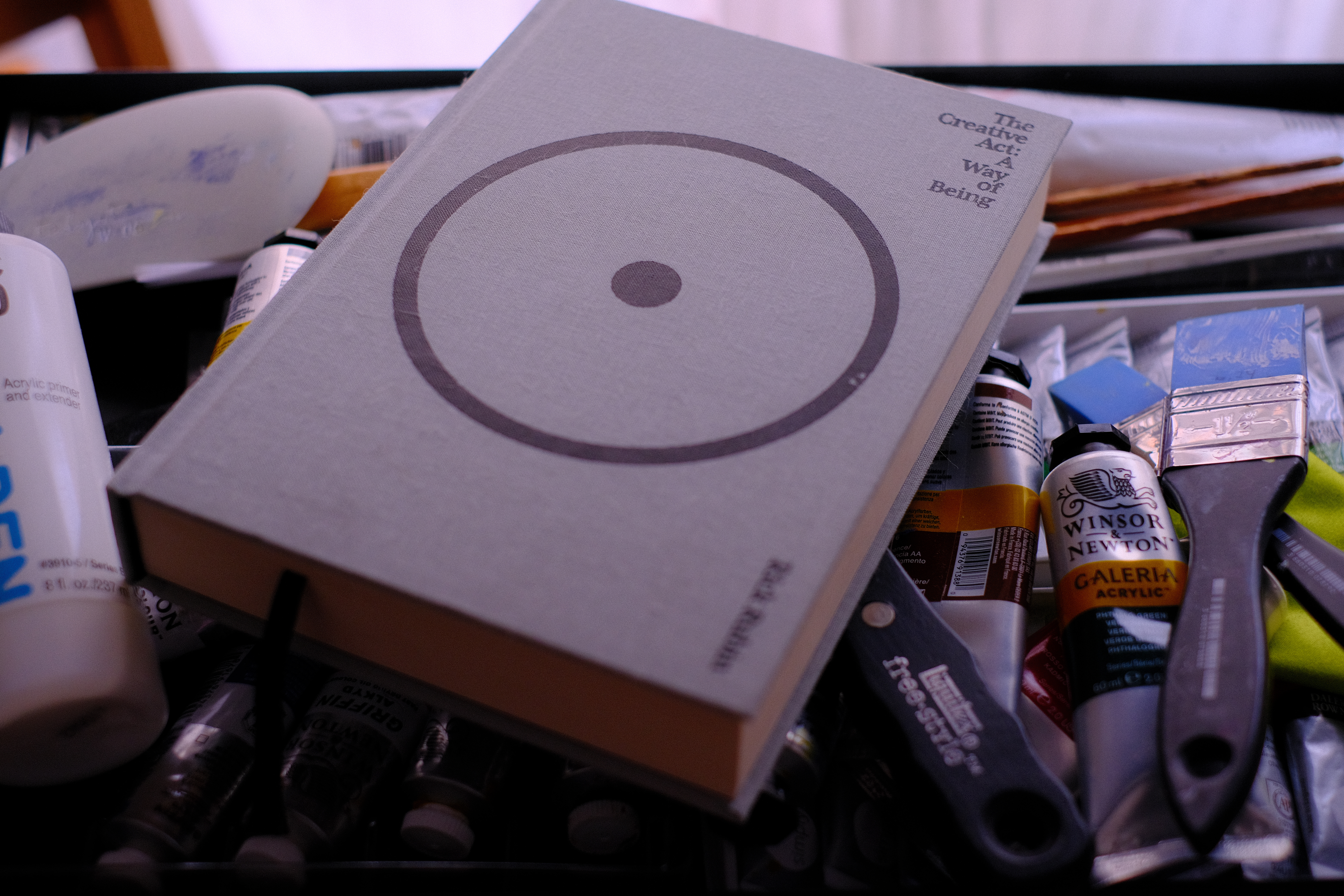
The Creative Act’s best
I’ve been talking nonstop about how I envision From Your Artist Friend as a space for creative people to express themselves, and my intention is to encourage them to do so by setting this example myself.
Just like taking advice from here and there, and taking things with a pinch of salt – which I highly encourage if you’re navigating the creative advice book space- I believe that we’re constantly making strides, moving like waves until eventually things such as this site are created. This exists thanks to the combination and careful ongoing improvement of many little moments, many attempts, many ideas, and many years.
Reading this book has been compelling because I can tell we’re at a time when a book like this is needed, I needed it, but at the same time its message can get easily lost, I think it already has become something to be put on a pedestal just for display, a signifier of sorts.
The thing is that, although this book definitely exists in the vicinity of attempting to explain ethereal concepts, with a very light sprinkle of symbolism, what surprised me about this book was that Rubin’s most potent phrases are the simplest ones.
I’d like to list the ones that have really made the book for me so far:
- “No matter what tools you use to create, the true instrument is you”
- “Not all projects take time, but they do take a lifetime”
- “There are no shortcuts.”
- “You have nothing to lose”
- “There is great power in not knowing”
- “Train yourself to see the awe behind the obvious”
- “The goal is to live your life in service of art”
- “Failure is the information you need to get where you’re going”
- “Descriptions do not do ideas justice”
- “Art may only exist by completing the work”.
My honest journey
There’s this tarot reader that I sometimes watch on YouTube. I enjoy his readings because he always gives sensible advice. I bet Rick Rubin would like his videos.
One thing he mentions sometimes is to ‘avoid calling out your weaknesses at this time’.
But I’d like to challenge this idea. We know what it’s like to meet a person that’s insecure and seeking exterior validation. This isn’t it.
For a good amount of time being an artist means being vulnerable, and I find that being confident in your exploration is actually a great strength.
We’re so used to societal pressures of “perfection”, which actually means convention. Adhering to what has been pre-established. People are embarrassed to try, but the ones that try and eventually succeed are then recognized by the mass.
Suddenly the people that never had a kind word of encouragement say they always knew you had it in you. To be fair, some of them did, but people have such a hard time feeling comfortable speaking the truth that we have a society that thinks it’s also embarrassing to say a heartfelt thing.
I definitely value each person that has shared a kind word about my work, that has shared their interest and best wishes. A lot of them see my attempt and then talk about how they too would like to try, and I am inclined to encourage them back. We need to stick together. ‘These are hard times for dreamers’.
Many of my “weaknesses”, listed so cuttingly in the first image above, are now strengths. I have worked to make them strengths. And I’ve been open about how difficult it is to liberate yourself, and many of the limiting structures that don’t respond to our nature of creating have lately been on display for all of us to see.
We can definitely agree that we’re collectively on a path of liberation, we are currently figuring out new paths, new solutions, new ways to build what we deeply desire. I believe the micro makes the macro, in the sense that a big part of having a free world comes from being free ourselves.
This is a challenging task, make no mistake. Especially with the hand that we were dealt collectively. But that makes it all the more relevant.
That means that we each must accept and embrace a truth that Rubin uses to start a chapter:
There. Are. No. Shortcuts.
Basically, the bad news and the good news is that the only way is through. And I’d add that failing openly, constantly and allowing yourself to have a more broad perspective where you feel free to break the rules, make up new ones and break those as well.
So anyway, here’s a shortcut you can take instead of reading the whole book, but you have got to actually do the work:
How to find your way back home as an Artist
1- Accept your calling
2- Reduce the interference of your filter (release prejudice)
3- Notice (connect with the cycles of the planet) and participate
4- Create artifacts with the intention to transcend.
5- Remember that you ARE indeed an Artist, and REPEAT.
Did you find this inspiring? Feel free to comment and share any valuable insights on what has helped your creative journey.
You can find me on Instagram @fromyourartistfriend,
Youtube @fromyourartistfriend,
and subscribe to my weekly Substack From Your Artist Friend.
V
All the products/services that I review on this site aren’t promoted or sponsored content, unless otherwise stated. I strongly believe that supporting fellow Artists also includes actually spending if/when you can, and recommending their work.


 From Your Artist Friend